Pure Spiral Architecture: Messier 33 and the Local Group Dynamics
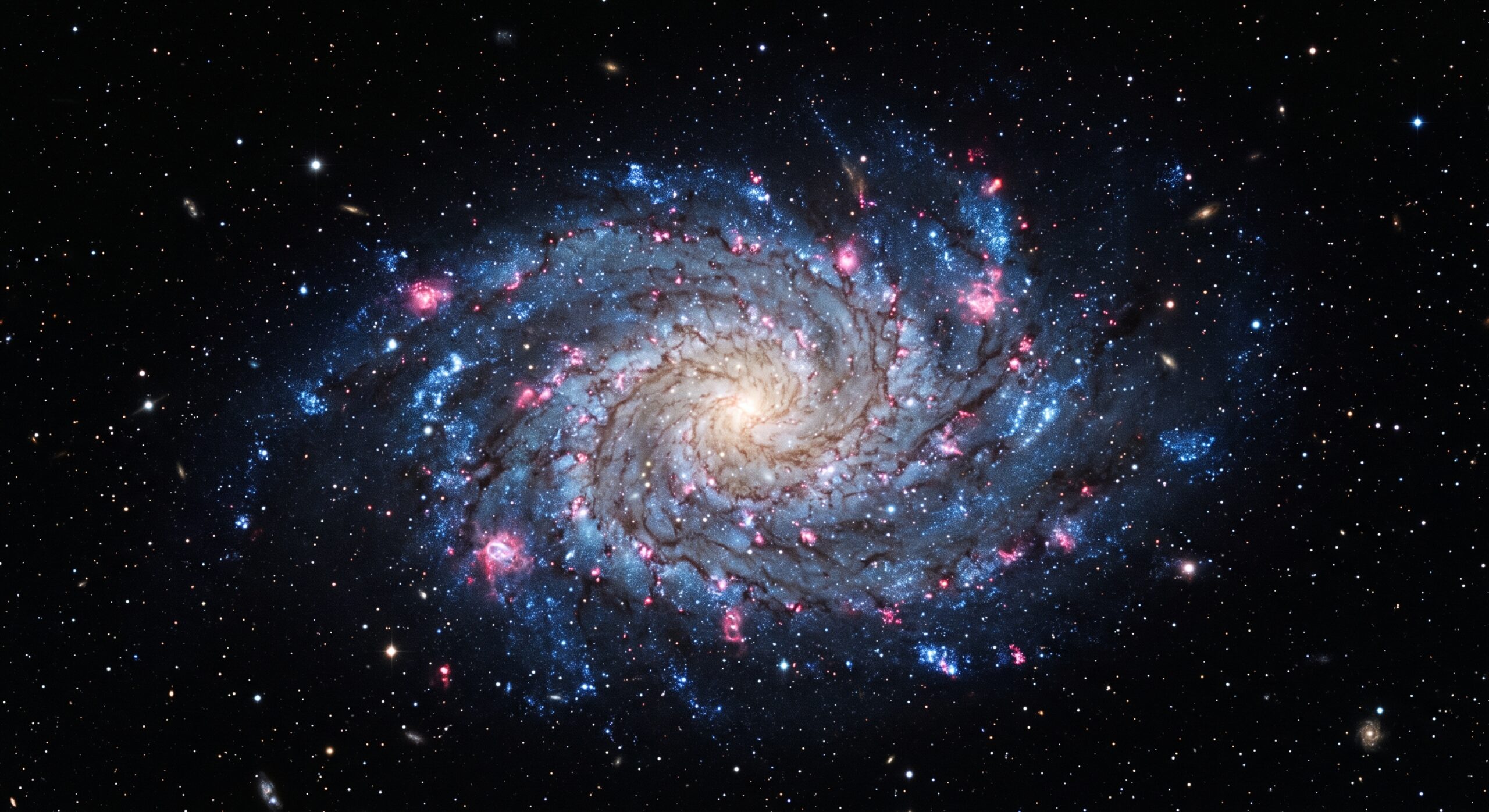
Featured on NASA’s Astronomy Picture of the Day, an intricate high-resolution portrait captures Messier 33 (M33)—widely celebrated as the Triangulum Galaxy. Located approximately three million light-years away in the small northern constellation Triangulum, M33 spans over 50,000 light-years in diameter, ranking as the third-largest member of our Local Group of galaxies behind the Andromeda Galaxy (M31) and the Milky Way.
Unlike the Milky Way or Andromeda, which feature prominent central galactic bulges and supermassive black holes, M33 represents an unbarred, pure disk spiral galaxy. Gravitationally bound as a satellite of Andromeda, M33’s loosely wound, flocculent spiral arms are traced by young blue star clusters, dark dust filaments, and hundreds of glowing pink hydrogen emission nebulae. Because it is oriented almost perfectly face-on to terrestrial observatories, M33 provides astrophysicists with an unobstructed, panoramic view of galactic star formation unobstructed by dense nuclear dust lanes.
The Cavernous Forge of NGC 604: Giant Molecular Clouds and Stellar Feedback
Among the myriad star-forming nurseries scattered along M33’s spiral arms, none rival the colossal H II region designated NGC 604, visible as the brilliant pink emission complex located at the five o’clock position from the galaxy’s center. Spanning more than 1,500 light-years across, NGC 604 is one of the largest and most energetic starburst nurseries in the entire Local Group, dwarfing the Milky Way’s Orion Nebula by a factor of forty.
High-resolution observations from the Hubble Space Telescope and the James Webb Space Telescope demonstrate the immense power of stellar feedback inside NGC 604. The nebula contains more than 200 massive O- and Wolf-Rayet-type stars, each packing tens to hundreds of times the mass of the Sun. Blistering ultraviolet radiation and relativistic stellar winds from these stellar titans have carved vast, cavernous cavities into the surrounding molecular gas, compressing the outer gas walls into ionization shock fronts where secondary stellar embryos are actively condensing.
Calibrating the Cosmic Ladder: Cepheid Photometry and the Hubble Tension
Beyond its morphological beauty, Messier 33 serves as a foundational anchor on the extragalactic cosmic distance ladder. Because M33 is sufficiently close for space telescopes to resolve millions of individual stars, astronomers have conducted exhaustive multi-epoch photometric surveys of its Cepheid variable stars and Tip of the Red Giant Branch (TRGB) populations.
Cepheids pulsate with periods directly proportional to their intrinsic luminosity, allowing astrophysicists to calculate precise geometric distances across extragalactic space. By pairing Hubble’s optical baseline with Webb’s infrared sensitivity—which penetrates interstellar dust and eliminates stellar crowding—researchers can precisely cross-calibrate Cepheid period-luminosity relations in M33 before extending measurements to distant Type Ia supernovae. These high-precision local distance anchors are vital to resolving the “Hubble Tension,” the ongoing discrepancy between local expansion rates and early-universe cosmic microwave background predictions.
References & Data Sources
- NASA APOD (Messier 33: The Triangulum Galaxy): https://science.nasa.gov/image-article/apod-2026-september-18-messier-33-the-triangulum-galaxy/
- NASA Science (Peering Into the Tendrils of NGC 604 with Webb): https://science.nasa.gov/missions/webb/peering-into-the-tendrils-of-ngc-604-with-nasas-webb/
- ESA/Webb Science Image Archives (NGC 604 NIRCam): https://esawebb.org/images/weic2407a/