NASA’s X-59: Unlocking the Future of Quiet Supersonic Flight
Breaking the sound barrier has always been a monumental challenge in the history of commercial aviation.
While the Concorde proved that passenger supersonic flight was possible, its operations were severely restricted due to the devastating sonic booms it created over land.
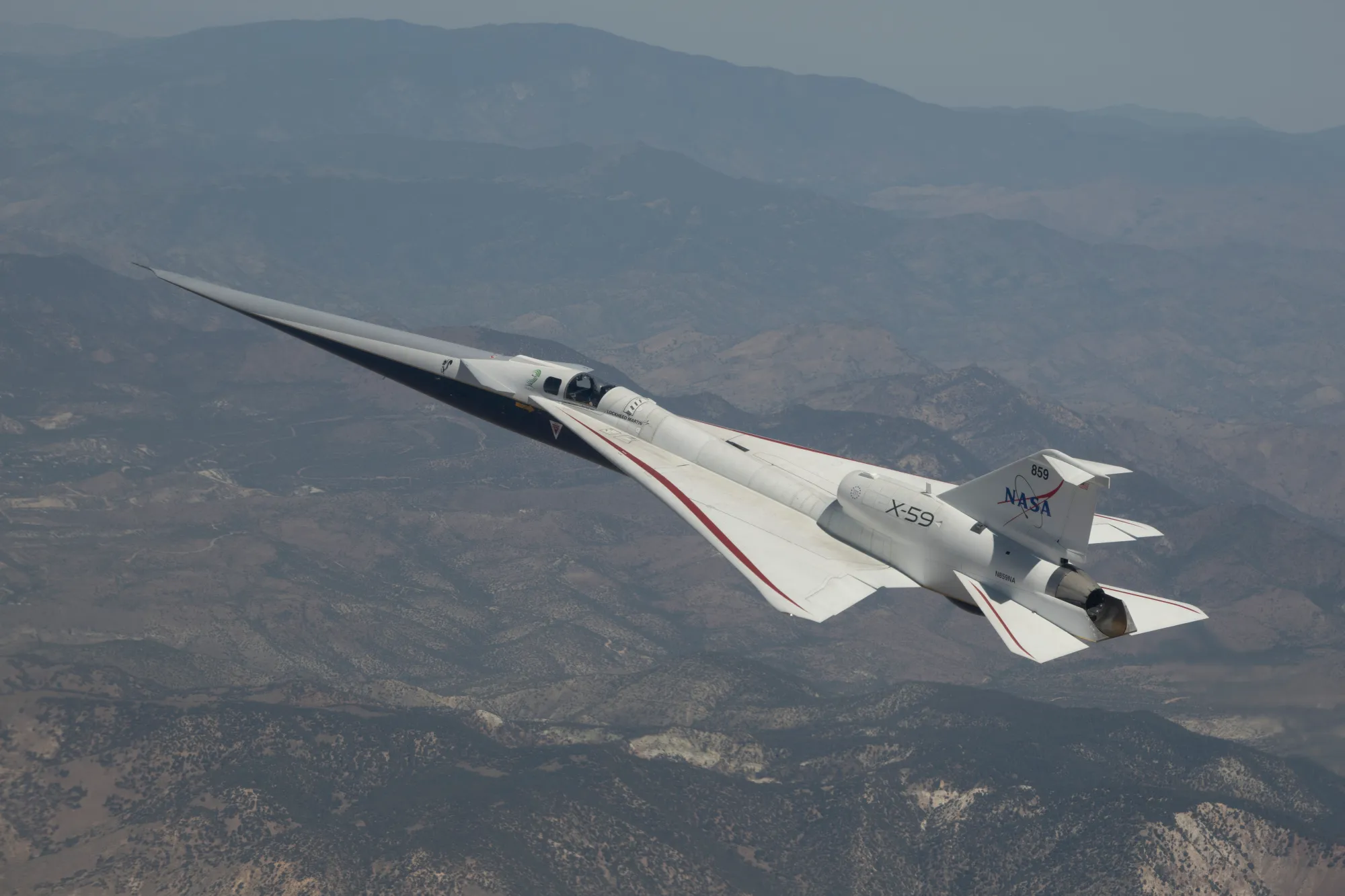
To overcome this significant environmental hurdle, NASA has partnered with Lockheed Martin to develop the X-59 Quiet SuperSonic Technology (QueSST) experimental aircraft.
This incredible machine is not just another fast plane, but a completely reimagined concept designed from the ground up to solve the noise problem inherent in supersonic travel.
The primary objective of the X-59 is to reduce the explosive sonic boom into a gentle “sonic thump,” barely louder than a car door closing down the street.
If this ambitious goal is realized, it could pave the way for lifting the decades-old ban on commercial supersonic flight over land, revolutionizing global travel networks.
Revolutionary Design for Quiet Flight
The most striking feature of the X-59 is its exceptionally long and slender profile.
The aircraft’s needle-like nose, which makes up roughly a third of its entire length, plays a critical role in preventing shock waves from merging and amplifying into a thunderous sonic boom.
Because of this extreme aerodynamic design, the cockpit lacks a traditional forward-facing window, making direct visual confirmation impossible for the pilot.
To compensate for this, NASA engineers have integrated the eXternal Vision System (XVS), an advanced array of high-resolution cameras and monitors that act as a virtual window.
Furthermore, placing the engine inlet on top of the fuselage helps physically shield the ground from the intense noise generated by the propulsion system.
All these innovative design elements work in perfect harmony to carefully manipulate and disperse shock waves, ensuring they reach the ground as mere ripples of pressure rather than disruptive blasts.
Final Preparations and Future Horizons
The X-59 is currently undergoing rigorous ground testing as it steadily prepares for its historic first flight and subsequent supersonic test runs.
Engineers are meticulously collecting vast amounts of data through engine runs and system integration checks to guarantee both pilot safety and the aircraft’s flawless performance.
Once initial flight testing is complete, the program will advance to community overflights across selected cities in the United States.
The primary goal of these real-world tests is to gather public feedback on the perceived sound of the sonic thump and determine if it is acceptable in everyday environments.
This invaluable acoustic data will then be handed over to regulatory bodies like the FAA and ICAO to help establish new sound-based rules for overland supersonic flight.
We are witnessing a pivotal moment in aviation history where the dream of faster, quieter skies is finally moving from the drawing board to reality.
Summary
NASA’s X-59 stands as a beacon of aeronautical innovation, tackling the environmental challenges of supersonic flight with groundbreaking engineering.
The data it gathers will be the key to unlocking a future where traveling faster than sound is an everyday reality.
Reference link:
https://www.nasa.gov/centers-and-facilities/armstrong/nasas-x-59-prepares-for-first-supersonic-flight/