A Cosmic Record Breaker: Unveiling the Youngest Planet Ever Discovered
In the ever-expanding field of exoplanet exploration, astronomers have just made a discovery that is truly rewriting the history books.
Scientists have confirmed the existence of Elias 2-24 b, an extraordinarily young world located approximately 450 light-years away from Earth.
What makes this celestial object so breathtaking is its age, which is estimated to be less than one million years old.
When you consider that our own solar system has been evolving for roughly 4.6 billion years, a million years is a mere blink of an eye in cosmic timescales.
This makes Elias 2-24 b a literal newborn in the universe, still wrapped tightly in its cosmic cradle.
The previous record holders for the youngest known planets were a four-way tie between worlds orbiting the stars PDS 70 and WISPIT 2, all of which are older than 5 million years.
This monumental finding completely shatters that record and provides humanity with an unprecedented glimpse into the earliest stages of planetary birth.
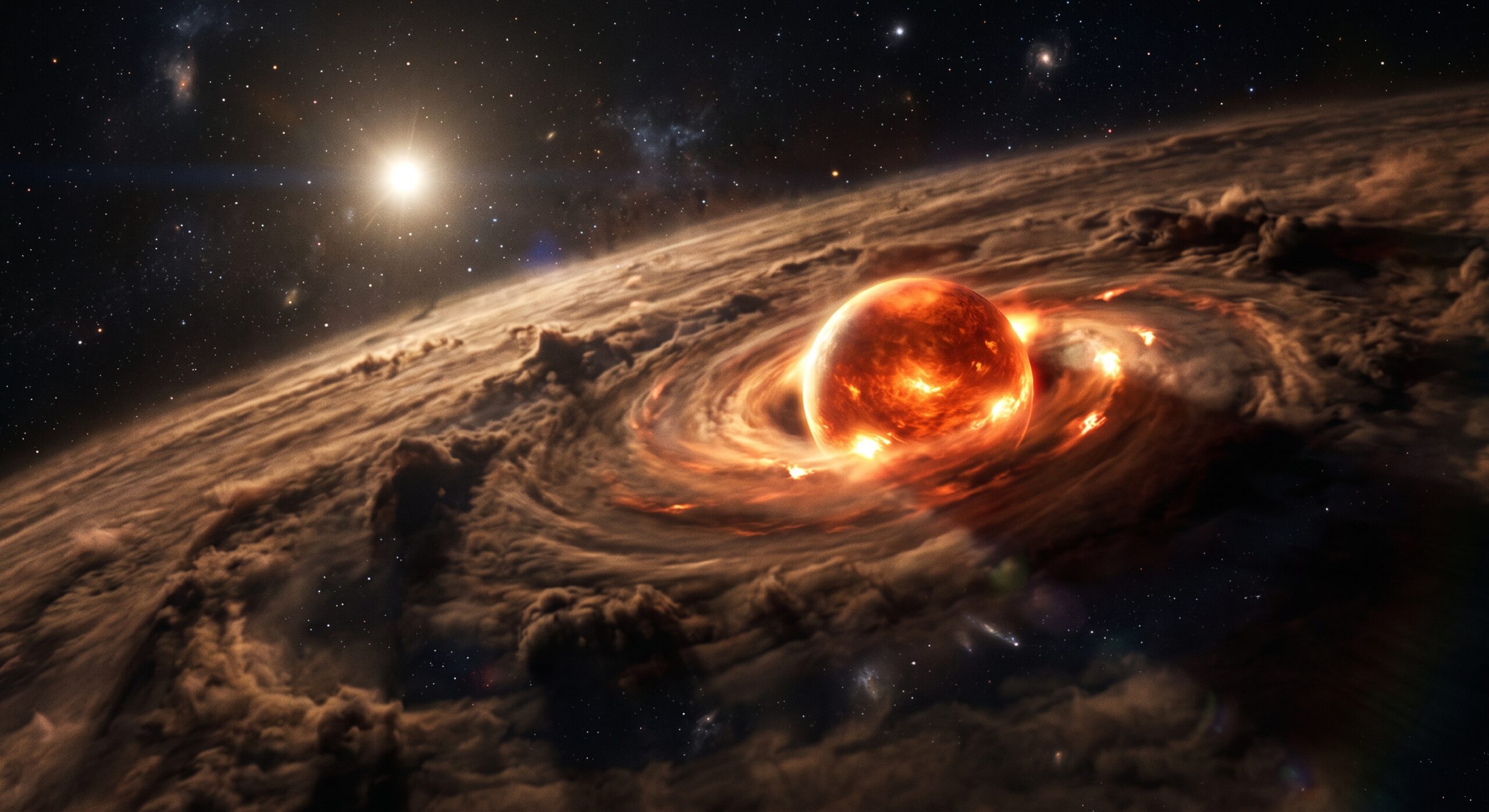
The baby planet already boasts a mass comparable to that of Jupiter, and it is actively sweeping up material from the dense natal disk of gas and dust that surrounds its host star.
Observing a planet while it is still actively feeding and growing within a protoplanetary disk is like finding the ultimate cosmic time machine.
It allows astronomers to directly witness the exact processes that sculpted our own solar system billions of years ago.
By looking deep into these dynamic stellar construction zones, we are taking a massive leap forward in understanding how worlds like our own ultimately come to be.
Defying the Laws of Physics: The Orbital Mystery of Elias 2-24 b
The primary reason this discovery has sent shockwaves through the astrophysics community is that Elias 2-24 b completely defies our current understanding of how planets form.
According to the core accretion model, which is the most widely accepted theory of planetary formation, it should take at least several million years for a gas giant the size of Jupiter to fully assemble itself.
Yet, somehow, this newborn world has managed to reach a Jupiter-like mass in a fraction of that expected time.
Even more perplexing is the extreme orbital distance at which this baby planet currently resides.
Elias 2-24 b orbits its host star at a distance that is 55 times greater than the distance between the Earth and the Sun.
To put that into perspective, it is sitting more than ten times further out than Jupiter is in our own solar system.
At such immense distances from the host star, the density of available gas and dust in the protoplanetary disk should theoretically be far too low to rapidly construct a massive gas giant.
Even our most advanced computer simulations and physical models cannot explain how such a massive planet could materialize so quickly and so far away from its star.
As the research team has boldly pointed out, this glaring contradiction indicates that our best planet-formation models are clearly missing a fundamental piece of the puzzle.
Astronomers are now being forced to reconsider alternative theories, such as the gravitational instability model, where a massive disk of gas suddenly collapses under its own weight to form a planet instantly.
Solving a Decade-Long Mystery Through Archival Exploration
This record-smashing discovery was not the result of a single, lucky night of telescope observation.
The story actually began about a decade ago when the Atacama Large Millimeter/submillimeter Array (ALMA) in Chile first spotted a suspicious, dark gap within the dusty disk surrounding the young star.
Sometime later, the Very Large Telescope (VLT) operated by the European Southern Observatory managed to detect a tremendously faint point of light hiding right inside that gap.
However, because existing theories stated that a planet simply could not form that early and at that distance, many scientists remained highly skeptical.
For years, the astronomical community fiercely debated whether this speck of light was a true planet, a background star, or just an unfortunate imaging artifact.
To settle the debate once and for all, a dedicated team of researchers turned to the rich historical archives of the W. M. Keck Observatory in Hawaii.
They meticulously combed through coronagraph data taken in 2018 and 2020, which uses a special mask to block the blinding glare of the host star so faint nearby objects can be seen.
By stitching these observations together, they successfully tracked the object’s precise movement over time.
Their exhaustive analysis proved beyond a shadow of a doubt that the light was moving in a clear orbit, confirming its identity as the planetary newborn Elias 2-24 b.
This incredible detective work highlights the immense value of revisiting archival data with fresh perspectives and modern analytical techniques.
With upcoming next-generation space observatories, we can expect to uncover even more of these hidden baby planets hiding in the dark.
Summary
Discovering such a newborn world challenges everything we thought we knew, proving that the universe is full of wonderful surprises just waiting to be found.